
Additional evidence for BIOLOX® delta bearings: nationwide Korean data on 15,299 total hip arthroplasties
| Study design |
|
| Key findings for BIOLOX®delta-on-BIOLOX®delta |
|
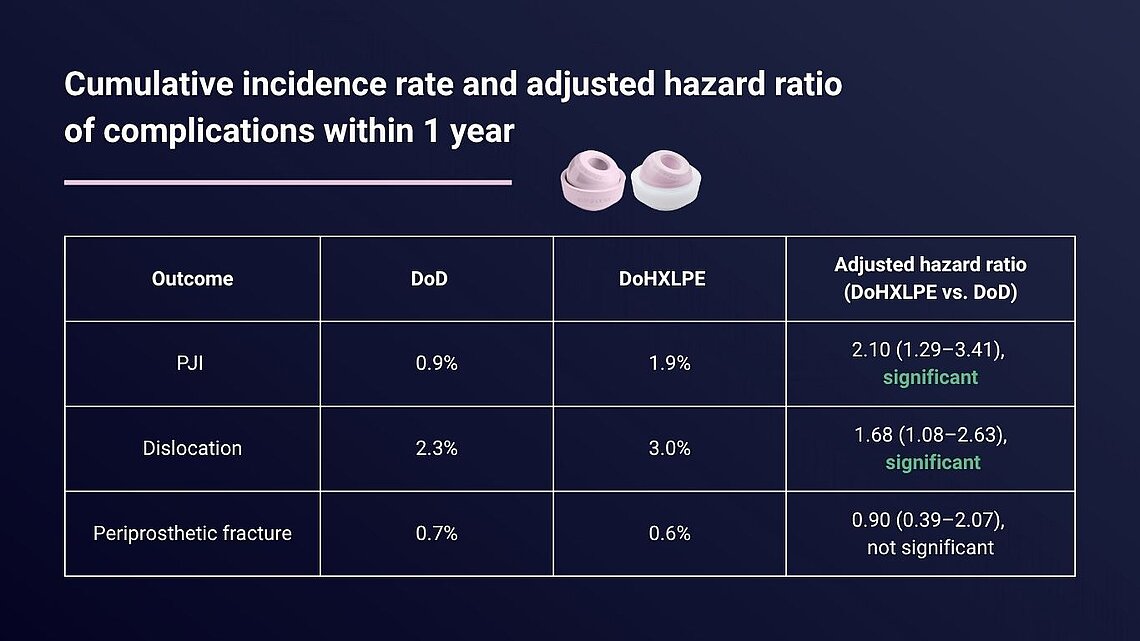
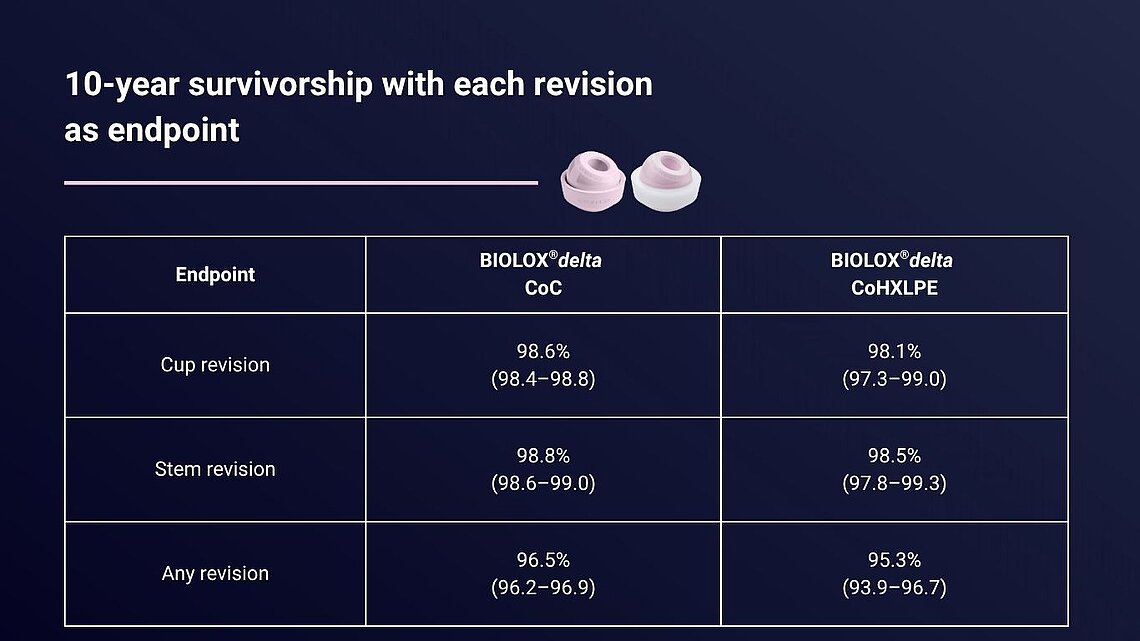
This was a retrospective claims-based cohort, so the findings show associations, not causation. The authors state the study does not demonstrate the superiority of either bearing. That said, in this large national cohort, BIOLOX® delta ceramic on ceramic bearings had consistently low complication and revision rates over ≤10 years. They were also associated with a lower risk of early periprosthetic joint infection than BIOLOX® delta ceramic on HXLPE.
They also note some limitations: the any-revision difference lost statistical significance after propensity score matching; the smaller DoHXLPE group limited statistical precision; and ceramic-specific complications such as squeaking, fracture, and liner malseating could not be captured in claims data.
Head size, surgical approach and implant position were not available. Ceramic-specific events such as squeaking or liner fracture could not be captured.
Other national registries, including the NJR, have reported different revision patterns.
The authors stress that prospective studies with detailed clinical and procedural data are still needed.
📖 Lee YK, Kang D, Kim H, Kang E, Cho J, Park JW. Comparative outcomes of delta-on-delta and delta-on-highly cross-linked polyethylene bearings in total hip arthroplasty: A nationwide cohort study. Archives of Orthopaedic and Trauma Surgery, 146, 338. 2026. doi: 10.1007/s00402-026-06502-1
Please check for regulatory approval in your country.
This text reflects CeramTec’s summary of a peer-reviewed scientific publication and does not constitute clinical guidance, risk prediction for individual patients, or product-related recommendations. For product, safety, and risk information, always refer to the labeling of the legal manufacturer.