You are about to access the “Professional Information” area of the CeramTec Medical website which is solely for Medical and Pharmaceutical Professionals. Please confirm that you are a member of this professional group.
The LROI Annual Report 2026 covers joint arthroplasty data up through December 31, 2025. Since 2007, 693,286 hip arthroplasty procedures have been documented, including 536,334 total hip arthroplasties (THA).
We’ve rounded up the key 2025 data to know:
Fixation
Uncemented fixation remained prevalent at 68.18%, largely stable in recent years.
Cemented fixation declined to 16.22%.
Hybrid fixation rose steadily from 4.90% (in 2016) to 13.21%.
Bearings (primary THA)
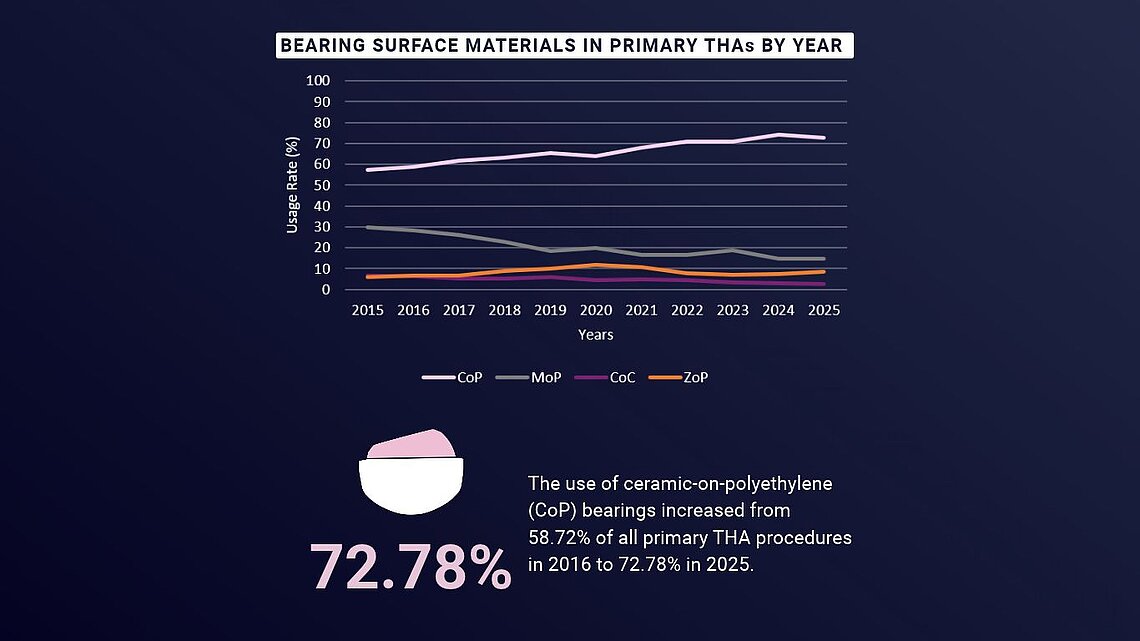
Ceramic-on-polyethylene (CoP) rose from 58.72% (2016) to 72.78%.
Metal-on-polyethylene (MoP) fell from 28.24% to 14.88%.
Ceramic-on-ceramic (CoC) fell from 6.18% to 2.64%.
Oxidized zirconium-on-polyethylene (ZoP) has remained within the range of 6.95% - 8.44% in the last few years.
Femoral heads
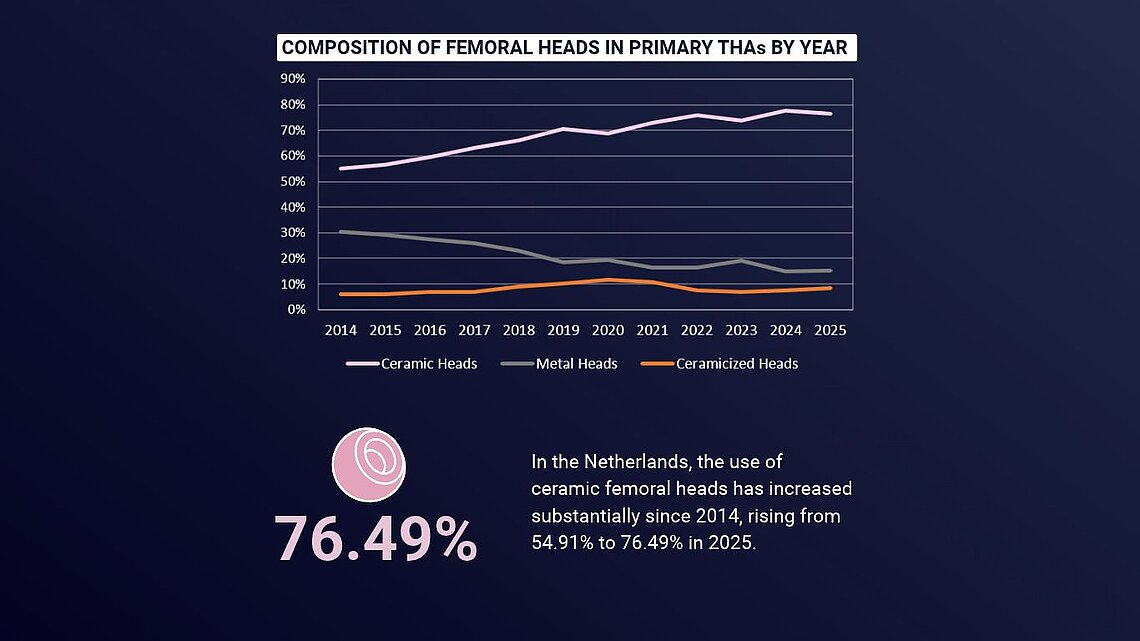
Ceramic heads reached 76.49%, up from 54.91% in 2014. Metal heads fell from 30.39% to 15.16%.
32 mm remained the most common size at 57.56%, though down from 66.64% in 2019. 36 mm rose from 21.48% (in 2016) to 31.50%.
Heads of 22-28 mm accounted for 10.73%. Heads of ≥38 mm were used in about 0.2% of procedures.
Revision
Most common reasons for revision within 10 years of primary THA, from 2007 to 2025: dislocation (24.92%), infection (23.27%), femoral loosening (17.65%), periprosthetic fracture (15.53%), acetabular loosening (11.55%).
Within one year: infection (41.82%), dislocation (22.53%), periprosthetic fracture (19.61%).
Patient-reported outcomes
Pre-operative PROMs response rates reached 55.28% in 2025. The LROI reports clear improvement from pre-operative to 12 months post-operative across all measures, including Oxford Hip Score, EQ-5D, and HOOS-PS.
Ceramic-on-polyethylene remains the most used bearing in THA. Early revisions are driven mainly by infection and dislocation, which keeps infection prevention and stability management central to outcomes.
This post reflects CeramTec’s summary of a peer-reviewed scientific publication and does not constitute clinical guidance, risk prediction for individual patients, or product-related recommendations. For product, safety, and risk information, always refer to the labeling of the legal manufacturer.