
New systematic review in The Knee: What does the clinical evidence say about metal-free ceramic knee arthroplasty?

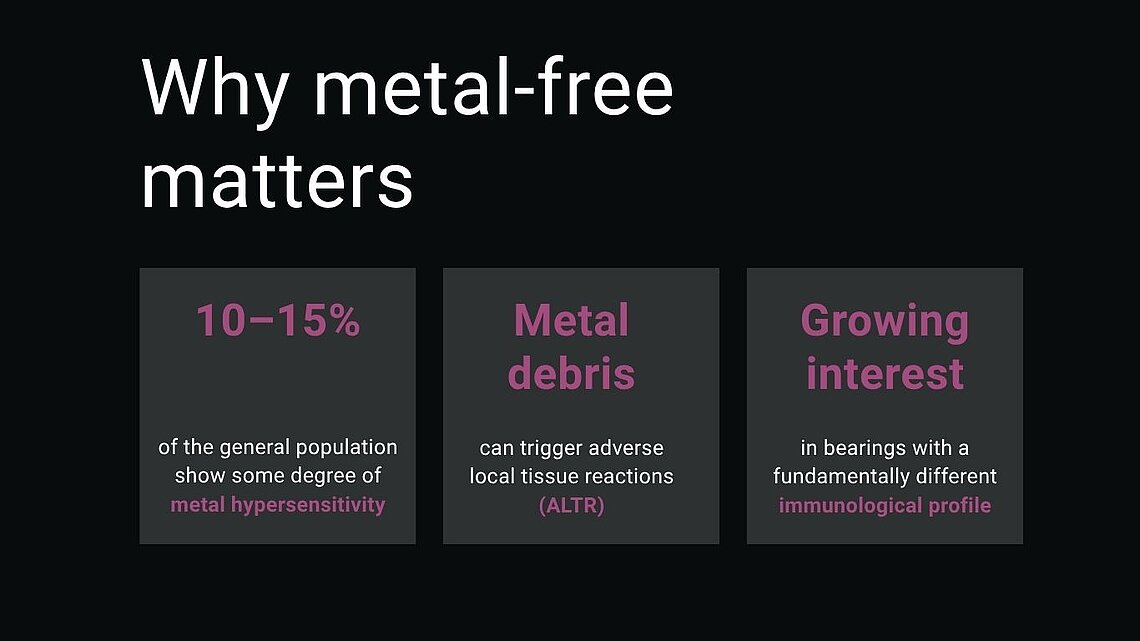
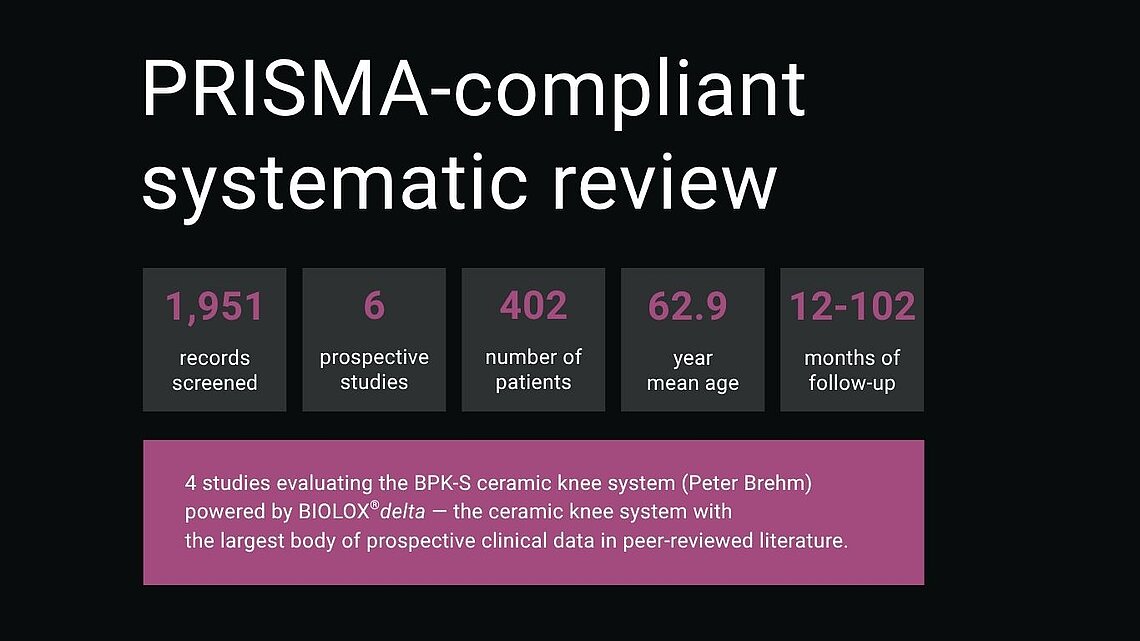

A recent PRISMA-compliant systematic review (Alhomayani et al., 2026) evaluated the effectiveness of metal-free ceramic TKA systems across six prospective studies (402 patients, 12-102 months follow-up).
A note on our reading of this review: The six included studies represent a range of knee replacement technologies. Two warrant brief clarification: Koshino et al. (2002) evaluated the YMCK® prosthesis, an alumina ceramic knee system developed by Kyocera. Glover et al. (2016) evaluated Oxinium™ (Smith & Nephew), an oxidized zirconium alloy with a ceramicized surface layer, a distinct material architecture from metal-free ceramic systems. Both are relevant contributions to alternative bearing surfaces.
We focus here on the four reviewed studies evaluating the @Peter Brehm BPK-S ceramic knee system powered by BIOLOX®delta, the ceramic knee system with a growing body of prospective clinical data in peer-reviewed literature.
Consistent findings on improved patient-reported general health, encouraging mid-term performance, and the absence of implant failure became evident across the four studies on the BPK-S ceramic knee system.
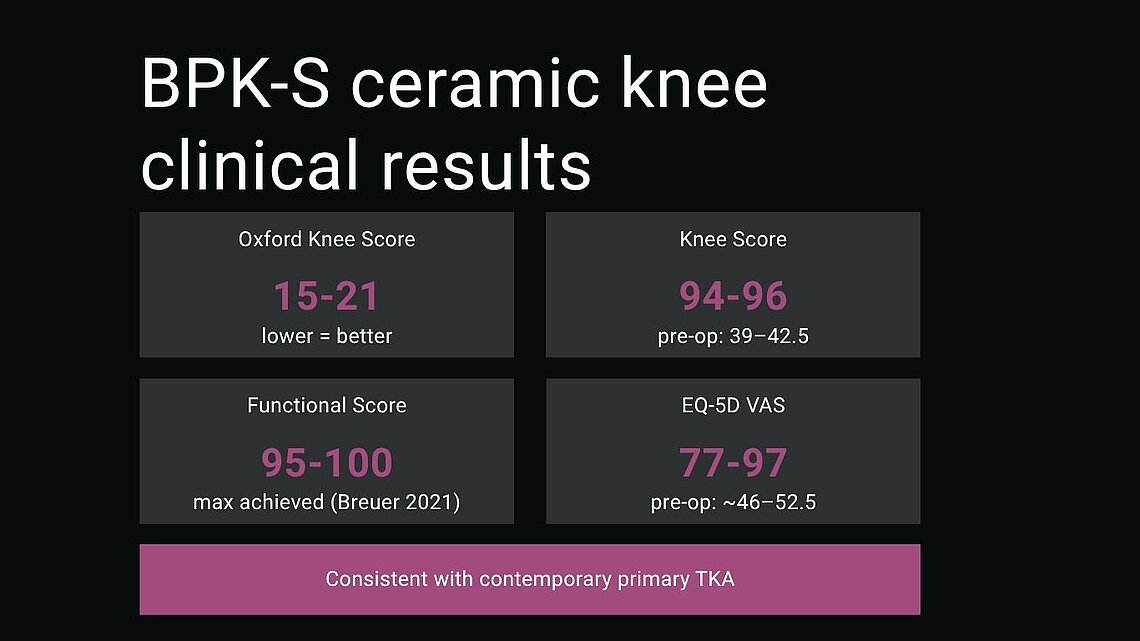
Clinical outcomes (BPK-S / BIOLOX®delta):
- Oxford Knee Score: ~39-41 → 15-21 post-op (lower = better)
- Knee Score: 39-42.5 → 94-96
- Functional Score: 54-60 → 95-100, with strong functional recovery across cohorts (Breuer et al. 2021 at 48 months)
- EQ-5D VAS: ~46-52.5 → 77-97
These results are consistent with contemporary primary TKA. The authors caution that, without head-to-head comparative data, these systems should not be interpreted as superior to conventional systems.
The limitations: evidence is observational, cohorts small, and data beyond 10 years sparse. Radiolucent lines were observed at high rates (up to 95% at 4 years, Breuer et al., 2021), though not associated with clinical failure at mid-term. Long-term radiographic surveillance remains essential.
The authors conclude that metal-free ceramic TKA is feasible, with encouraging short- to mid-term outcomes. For patients where the biological and immunological response to implant materials is a primary consideration, this evidence provides an important early foundation. Comparative studies with long-term follow-up are the necessary next step.
📖 Alhomayani KM, Khubzan WD, Alharbi MT, Alharbi ZS, Alqahtani NM, Alhawiti MS, Alshmrani LS, Al-Awn RM, Bukharya HA. Evaluating the effectiveness of completely metal-free ceramic total knee replacement compared to traditional metal-based implants: a systematic review. Elsevier 2026. doi:10.1016/j.knee.2026.
Please check for regulatory approval in your country.
This text reflects CeramTec’s summary of a peer‑reviewed scientific publication and does not constitute clinical guidance or product‑related recommendations. This post was created with the support of AI.